My neighbor Dave, over in Fishers, used to dread January. The AES bill would land with a thud, and he'd spend a week grumbling about the cost of keeping his 1970s split-level warm. One winter, he tried turning the heat way down during the day while he was at work—65°F to 58°F—then cranked it to 72°F the second he walked in. The furnace ran like crazy every evening, the house still felt drafty, and the bill barely budged. Sound familiar?
What Dave didn't know is that manual fiddling like that is a losing game. A programmable thermostat is the fix for that exact cycle. It learns your habits (or you program them yourself) and adjusts temps automatically so you're not heating or cooling an empty house. The U.S. Department of Energy says you can trim about 10–15% off your heating and cooling bills just by setting the temperature back 7–10°F for 8 hours a day. That's not a guess—field studies back it up, and here in central Indiana, where winter cold snaps can park in the teens for a week and summer humidity makes 85°F feel like a sauna, that 15% really adds up.
Why a Programmable Thermostat Saves Energy
The magic isn't complicated. Your furnace or AC works hardest when it's trying to maintain a big temperature difference between indoors and outdoors. During a January night in Noblesville, when it's 10°F outside, keeping your living room at 70°F takes a ton of energy. But if you're asleep under a pile of blankets, 62°F feels perfectly cozy. A programmable thermostat takes advantage of that: you set a schedule so the heat dials down after you go to bed, then warms back up about 30 minutes before your alarm goes off. Same idea for summer—let the house drift warmer while you're at work in Carmel, then cool it down right before you get home.
Those automatic adjustments, called setbacks, slash your total run time without you ever touching a dial. The Department of Energy's 7–10°F guideline works for most conventional furnaces and air conditioners. Just don't go too deep for too long if you have a heat pump (more on that in a minute), or you might trigger the expensive auxiliary heat strips and wipe out your savings.
The Right Thermostat Schedule for Indianapolis Seasons
Our weather isn't gentle. Winters can deliver single-digit mornings, and summers routinely hit the 90s with air you can wear. Your programmable thermostat needs a schedule that matches.
Winter settings for gas furnaces and heat pumps
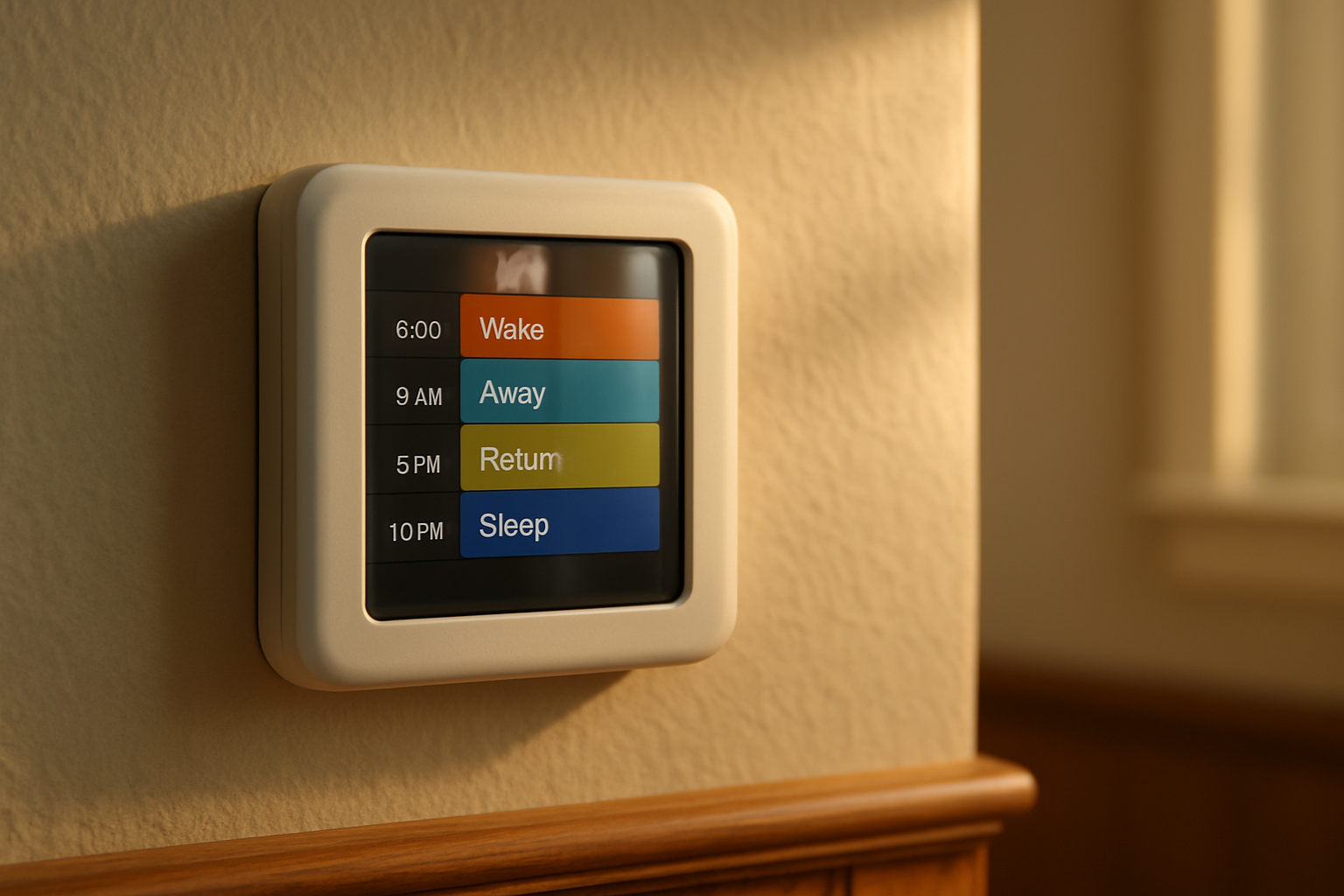
For a typical gas furnace, try this: * 6:00 a.m. – 68°F (wake) * 8:00 a.m. – 60°F (leave for work) * 4:30 p.m. – 68°F (return) * 10:00 p.m. – 62°F (sleep)
If you have a heat pump or dual-fuel system, be more gentle. A deep setback on a heat pump—say, dropping from 68°F to 60°F—can fool the system into thinking it's an emergency and fire up those pricey auxiliary strips. Instead, limit heat pump setbacks to 3–4°F. A smarter move is an adaptive recovery feature. That tells the thermostat to learn how long your home takes to warm up and start the heater early enough to hit your target temp without kicking in the strips. If your programmable thermostat doesn't have adaptive recovery, you might be better off with a smart thermostat that learns your heat pump's rhythm. For more on heat pump quirks in cold weather, check out our guide on heat pump performance in Indiana.
Summer settings for AC and heat pumps
Indianapolis humidity makes cooling trickier. Set it higher when you're gone—say 78°F—and bring it down to 74°F an hour before you return. That's usually a 4°F setback, which is plenty without making the unit work too hard. If you have a whole-house dehumidifier or a thermostat with humidity control, you can even set it a couple degrees higher and still feel comfortable because dry air feels cooler. (If your humidity is out of whack, read our post on whole-house humidifiers for winter and consider a dehumidifier for summer.)
Smart vs. Programmable: What Actually Matters in Indy Homes?
Walk into any big-box store and you'll see dozens of thermostats. The $30 basic programmable will do setbacks. The $250 smart one adds Wi‑Fi, geofencing, and learning. Which one actually helps you save?
For most Indianapolis homeowners, the sweet spot is a mid-range programmable model with a clear screen and 7-day scheduling. Smart thermostats get you geofencing—your phone tells the system when you've left or are on your way home, so it adjusts automatically. That's handy if your schedule changes a lot. But many older homes in Broad Ripple, Meridian-Kessler, or Irvington lack a C-wire (the common wire that powers smart features) and may need a professional to run a new wire or install an adapter. A basic programmable thermostat can often run on batteries, no C-wire needed, so it's a simpler upgrade for older stock.
Smart thermostats also offer remote sensors that average temperatures across rooms and occupancy detection that avoids heating an empty hallway. Those can boost comfort in a drafty two-story, but they rarely pay for themselves purely through savings. The real energy improvement comes from that 7–10°F setback, which even a dumb programmable does fine.
Thermostat Placement: Don't Sabotage Your Savings
Where you stick the thermostat matters more than you'd think. If it's in a sunny bay window in Greenwood or right above a heat vent in Brownsburg, it'll think the whole house is toasty and short-cycle your furnace—leading to uneven temps and wasted energy. I've seen one in a Westfield kitchen that would read the oven's heat every time dinner cooked, sending the AC into overdrive in September.
Best practice: mount the thermostat on an interior wall, about 5 feet off the floor, away from direct sunlight, drafts, and supply vents. Not near a return air grille either—the rushing air can throw off the sensor. If your house has hot spots, consider a thermostat with a remote sensor, but at least get it out of the worst spots. And if you're worried about short cycling after a new install, our piece on furnace short cycling has the fixes.
Local Rebates That Cut the Cost
Both AES Indiana and Duke Energy Indiana offer occasional rebates or demand-response programs for smart and programmable thermostats. Sometimes you can snag a deal during the spring or fall, right before the heating or cooling season kicks in. We keep a running list of what's active on our Indiana HVAC rebates page, so bookmark it. A rebate can often pay for a mid-range thermostat and part of the installation, so don't skip this step.
Addressing the Worries We Hear Most
"I'm worried a programmable thermostat is too complicated." I get it. But once you set a schedule, you rarely touch it again. The screen walks you through Wake, Away, Return, Sleep. HVACPros sets up the initial program with you, so you won't be deciphering a manual at midnight.
"My home is older; will it even work?" Most older homes can take a basic programmable thermostat without any rewiring. We do a compatibility check before anything gets unboxed. If you don't have a C-wire, we can often work around it with a simple battery model.
"Won't deep setbacks make the house uncomfortable or freeze my pipes?" Setbacks of 7–10°F for 8 hours won't freeze pipes in an insulated home, even when it's 0°F outside. And the recovery runs in the morning before you're out of bed, so you don't notice a thing.
"I've heard heat pumps shouldn't be set back at all." It's a half-truth. You can set back a heat pump, just more moderately—3–4°F. Or use adaptive recovery. With a smart thermostat that understands your heat pump's needs, you can still save without triggering auxiliary heat.
"What if I rent?" You can often use a plug-in smart thermostat that doesn't require hardwiring, or get your landlord's permission for a battery-powered programmable unit that you take with you when you move.
How HVACPros Makes It Simple
You don't need to be a wiring wizard. Our process in Indianapolis and the northern suburbs is: you call or text, we talk through your system type and what you want (maybe you're sick of the old mercury dial in your Plainfield living room). We schedule an on-site visit—often same-day or next-day in neighborhoods like Carmel, Fishers, Zionsville, Noblesville, Greenwood, and beyond. We check compatibility, run a C-wire if needed, mount everything cleanly, and program a custom schedule that fits your family's routine. Before we leave, we walk you through it so you're confident.
Don't let another season of high bills slide by. Request a quick thermostat compatibility check and quote—it's free, takes maybe 15 minutes, and could be the easiest 15% you ever save.
Ready for HVAC service or an upgrade?
NATE-certified techs, flat-rate diagnostics, and a free in-home assessment for any replacement — no pressure.