I was at a backyard barbecue in Broad Ripple last fall, and my neighbor Mike pulled me aside. “You’re in the HVAC world, right? My furnace is 18 years old, and I keep hearing about heat pumps. But come on, do those things actually work when it’s 10 degrees out?” He wasn’t the first person to ask, and he won’t be the last. There’s this stubborn rumor floating around Indianapolis that heat pumps give up as soon as the temperature dips below freezing. And sure, thirty years ago, that was mostly true. But the technology has quietly pulled a full 180—modern cold-climate heat pumps don’t just survive Indiana winters, they can thrive in them. If you’re wondering “do heat pumps work in cold weather Indiana”, the short answer is yes—but how well depends on the right equipment, the right design, and a few local quirks we’ll walk through. (And no, this won’t read like an engineering textbook. I promise.)
Why old heat pump myths still hang around
You’ve probably heard the horror stories: a heat pump that turned into a block of ice, sky-high electric bills, or a house that never got above 62°F in January. Those stories come from the early days, when single-stage heat pumps lost capacity fast as outdoor temps dropped. They often couldn’t keep up below 30°F. But today’s inverter-driven, cold-climate heat pumps are a completely different animal. Units like Mitsubishi’s Hyper-Heat or Carrier’s variable-speed models can deliver full heating capacity down to 5°F and keep running at -13°F or lower. A good cold climate heat pump Indiana install doesn’t rely on old school tech—it uses smart compressors that speed up or slow down to match the exact load, which means steady heat even when a polar vortex sneaks down from Canada. The key phrase here is do heat pumps work below freezing? Modern ones sure do, and they do it efficiently.
That said, it’s not just about the box outside. The science of keeping an Indianapolis home comfortable boils down to how the system is sized and matched to the house. A unit that’s too big or too small, or slapped onto leaky ducts, won’t perform right no matter the brand.
Design is what actually keeps you warm
Here’s something we see all over older Indy neighborhoods like Irvington or Meridian-Kessler: a homeowner buys the most expensive heat pump, but they still get cold spots or the outdoor unit runs constantly. Why? Because nobody ran a proper Manual J heat load Indianapolis. A Manual J is a room-by-room calculation that measures how much heat your house loses on the coldest expected day. It accounts for your windows, insulation, air leaks, even which way the house faces. Without it, you’re just guessing—and in a hundred-year-old bungalow, that guess can be wrong by a ton.
We also check ducts with Manual D and pick equipment with Manual S, so your inverter heat pump winter performance doesn’t get choked by undersized ductwork. Homes in Carmel, Fishers, or Westfield often have newer construction, but even there, builders sometimes cut corners on duct runs or returns. A variable-speed heat pump needs proper airflow to do its job—otherwise you end up with noisy registers and efficiency that’s nowhere near the label. The real comfort magic of a heat pump isn’t the brand badge; it’s the design homework done before a single wire gets connected.
Dual-fuel: the best of both worlds for Indy winters
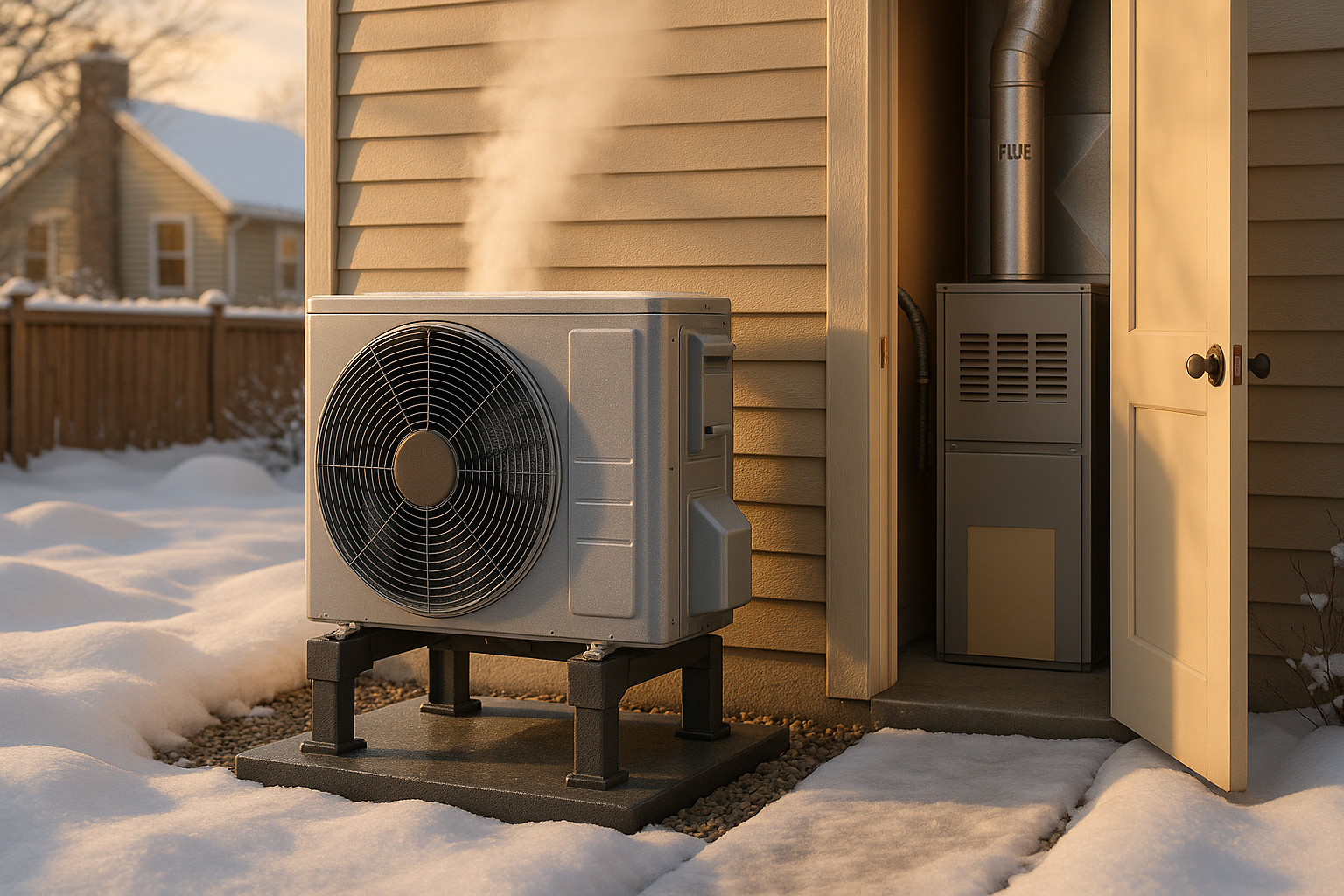
Plenty of Indianapolis homes already have natural gas piped in, so a dual-fuel heat pump Indianapolis system makes a ton of sense. Here’s the idea: you install a high-efficiency heat pump that carries the heating load through the 30s, 20s, maybe even the teens. Then, when it drops to a set point (say, 10°F or 5°F—whatever you and your installer decide), a smart control switches to the existing gas furnace for backup. You get the cheap, efficient electric heat most of the season and the brute force of gas only during those handful of bitter nights. That setup puts you in control of operating costs, especially with local utility rates from AES Indiana or Duke Energy.
A dual-fuel heat pump also bypasses the whole “do heat pumps work in subzero temperatures” debate. They absolutely can, but with dual-fuel, you don’t have to test that limit if you don’t want to. It’s a really practical solution for the heat pump vs furnace Indiana conversation—you get both. And if you’re concerned about auxiliary heat strips vs gas backup, know that electric strips can work all-electric too, but in a house that already has gas, the furnace backup is often cheaper to run when it’s truly frigid.
Outside unit placement and that weird defrost steam
Indiana winters throw everything at you: snow, freezing rain, black ice, and those days where it warms up just enough to drip off the roof then refreeze at night. That’s why where you put the outdoor unit matters. You’ve got to elevate it on a stand above typical snowline—at least 12 inches, sometimes more if a drift builds near a fence. Keep it out from under roof edges where ice crashes down, and make sure there’s good drainage so the defrost cycle heat pump winter doesn’t turn into a glacier.
And about that defrost cycle—when you see steam puffing off the outdoor unit on a cold day, it’s not a breakdown. It’s the system reversing briefly to melt frost off the coil. Perfectly normal. Some units even have a pan heater to keep the bottom from icing up. Good outdoor unit snow clearance and a little planning go a long way. We’ve seen units buried in snow in Avon after a lake-effect blast because nobody gave them a sturdy stand. A few extra bucks on a composite pad and risers is way cheaper than a service call in the dark.
But won’t my electric bill spike?
This is often the first question, and it’s fair. With gas prices doing their thing and electric rates climbing too, the math can shift. A modern cold-climate heat pump can have a COP of 2 to 3 even at 17°F—that means for every dollar of electricity you put in, you get two to three dollars’ worth of heat out. So in many conditions, it’s right in line with natural gas on cost, sometimes better. We model it based on your actual utility rates, so there’s no guessing. And if your house has good attic insulation and air sealing (something we always poke around when we’re doing a quote), the overall bill can drop no matter what you’re running.
There’s also money on the table to help with the upfront cost. The Inflation Reduction Act offers a federal IRA heat pump tax credit, and there are rebates for heat pumps Indiana through some local utilities. We’ll help you track down what applies and handle the paperwork—it’s part of the service, not an add-on. If your electrical panel is maxed out, an electrical panel upgrade for heat pump might be needed, but we can evaluate that in the planning visit. Some homes in Greenwood or Brownsburg need a sub-panel; others do just fine with a dedicated breaker. It all gets sorted before we start.
What it’s actually like living with a heat pump
Okay, so you convert. What changes? For one, the air coming out of the registers is going to feel different—it’ll be around 90–100°F, not the 120°F blast from a furnace. It’s still “warm,” and because a variable-speed heat pump runs longer, lower cycles, the house stays ridiculously even. No more hot flash in the kitchen while the back bedroom is freezing. It’s also quieter—both inside and out. You’ll probably notice the outdoor unit humming softly rather than roaring, which matters on tight lots in older neighborhoods or quiet cul-de-sacs in Zionsville.
Maintenance is pretty straightforward: change the filter, keep the outdoor unit clear of leaves and snow, and have a seasonal checkup to confirm refrigerant charge and defrost controls. Think of it like an oil change for the system. A simple plan like what we offer in Westfield’s maintenance programs keeps things running slick. And if you’ve got an older home with radiators or iffy ducts, we sometimes recommend ductless mini-splits that skip the ductwork entirely. There’s always a way that works for your house.
Let’s figure out your house—not a generic guess
Every home from Plainfield to Noblesville has its own personality. You might need a cold climate heat pump Indiana with electric strips in a well-insulated ranch, or a dual-fuel heat pump Indianapolis in a big two-story where the furnace only kicks on when the temperature drops to single digits. Instead of scrolling spec sheets and hoping for the best, grab a time for us to come do the real thing: a room-by-room load calculation, duct review, and operating cost comparison based on your rates. We’ll lay out your options in a written scope—cold-climate, dual-fuel, or even a hybrid with mini-splits—so you can make a decision with no pressure and no guesswork.
If you’re ready to stop wondering “do heat pumps work in cold weather Indiana” and start planning one that actually fits your home, reach out for a visit. You can also jump straight to our quote request form to get the ball rolling. We work all over the Indy metro: Indianapolis, Carmel, Fishers, Zionsville, Westfield, Noblesville, Greenwood, Brownsburg, Avon, and Plainfield. Let’s get your place cozy and efficient before the next cold snap hits.
Ready for HVAC service or an upgrade?
NATE-certified techs, flat-rate diagnostics, and a free in-home assessment for any replacement — no pressure.