Last February, my buddy Dave in Broad Ripple called me, absolutely fed up. Every morning he’d shuffle across his 1920s hardwood floors and zap the doorknob. His nose bled. His toddler’s eczema looked angry. He’d tried a few drugstore humidifiers that just wheezed into a single room. “Is there a whole-house humidifier that actually works for Indianapolis winters?” he asked. (Spoiler: yes, there is.)
Why Indianapolis Winters Suck the Moisture Out of Your Home
Cold air can’t hold much water. When that dry outdoor air leaks into your house and your furnace heats it up, the relative humidity inside can drop below 25%. That’s Sahara-dry. For most homes in Indy—especially those with hardwood floors and original trim in neighborhoods like Meridian-Kessler or Irvington—that kind of dryness is a slow-motion disaster. Wood shrinks, gaps open up between floorboards, trim pulls away from the wall. You feel it in your sinuses, your skin, even your sleep. The sweet spot for winter humidity is 30–50%. Without a whole-house humidifier, you’re lucky to hit 20% by February.
Signs Your Home Is Begging for a Whole-House Humidifier
If you’re shuffling across carpet and getting shocked every time you touch a light switch, that’s static—classic dry-air symptom. Nosebleeds? Dry skin? Creaking floors that didn’t used to creak? These are all red flags. Dave mentioned his acoustic guitar’s neck warped slightly—another tell. Even your houseplants start looking crispy around the edges. A portable humidifier might help a little, but it’s like trying to heat a whole house with a space heater. To get consistent comfort everywhere, you need a system that hooks into your ductwork.
Bypass, Fan-Powered, or Steam: Which Humidifier Fits Your Indy Home?
No single style wins for every house. Here’s the breakdown.
Bypass Humidifiers
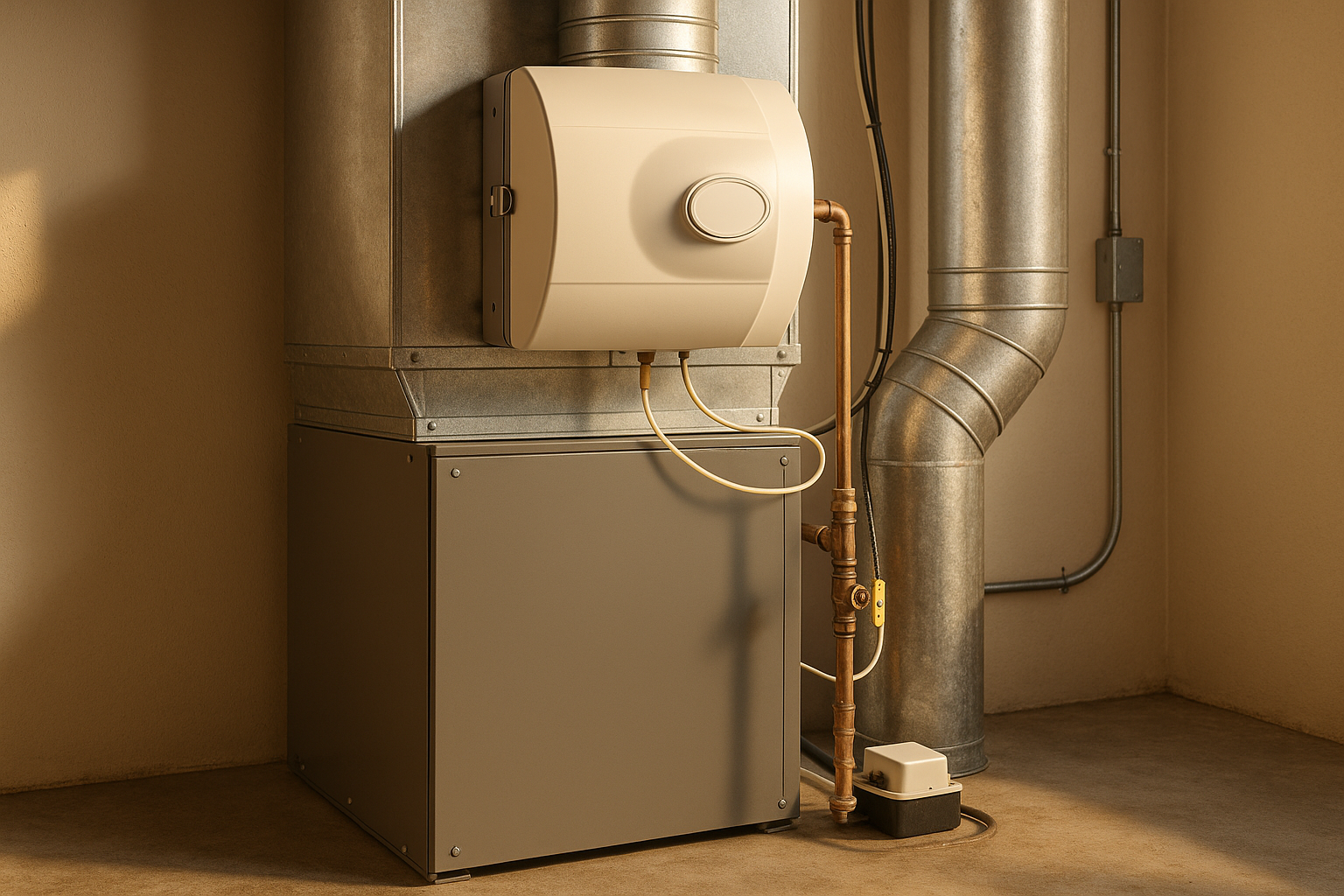
These are the most common. A bypass unit taps into your furnace’s blower and sends air through a wet water panel. They’re budget-friendly ($500–$900 installed) and do a decent job in average-sized homes with a gas furnace. The catch? They need a bypass duct, which steals a little airflow, and they only humidify when the furnace runs. If you’ve got a short-cycling system, you might not get enough moisture.
Fan-Powered Humidifiers
Think of this as a bypass unit with its own fan. It pushes air through the water panel on its own, so you get more output and don’t rob air from your ductwork. It’s a solid choice for larger homes or when you want more consistent humidity without waiting for the furnace to kick in. Installed cost is a bit higher—typically $600–$1,100.
Steam Humidifiers
A steam unit uses electricity to boil water and inject actual steam into your ductwork. This gives you the most precise control and the highest capacity. It works great with any system—gas, electric, heat pump, variable-speed—and doesn’t need the furnace to be running. For big, leaky, or really tight homes, steam is often the only way to hit that 30–50% target without cooking your energy bill. The downside? It’s the priciest option ($1,200–$2,000+ installed) and uses more electricity. But if you’ve got a historic Broad Ripple bungalow with original single-pane windows and you want to avoid that freeze-thaw condensation dance, steam with an outdoor reset sensor is the ticket.
If your home has a heat pump, you’ll want to pay close attention to compatibility—some systems can’t maintain enough heat for a bypass, so fan-powered or steam becomes the smarter upgrade. (We’ve got a whole post on heat pump cold-weather performance here.)
Hard Water in Indianapolis: A Real Battle for Humidifiers
Let’s be real: Indy water is hard. Like, “scale up your coffee maker in a week” hard. That’s a problem because humidifier water panels and steam canisters hate mineral buildup. If you go with a bypass or fan-powered unit, expect to swap the water panel at least once a season—sometimes twice if your water is really aggressive. You can add an inline water filter to reduce scale, but it’s not a miracle cure. Steam units handle hard water a little better if you get one with a replaceable canister (like an AprilAire 800), but you’ll still replace that canister yearly. Bottom line: don’t ignore the hard water factor. A little planning upfront keeps the maintenance from driving you nuts.
Installation and Compatibility: Will It Work With My Furnace?
Most Indianapolis homes have gas forced-air furnaces, so the answer is usually yes. But it’s not always plug-and-play. A good installer will check your furnace’s CFM, your home’s square footage, and the envelope tightness to size the right unit. Variable-speed blowers are great—they pair nicely with fan-powered or steam humidifiers because they can run continuously to circulate moisture even when there’s no call for heat.
Water supply needs a proper shutoff valve, and you’ll need a drain line nearby—either to a floor drain, sump pit, or condensate pump. Steam units require a dedicated electrical circuit (like a 120V or 240V feed), so that can add to the installation cost if your panel isn’t close. Mounting is clean and out of the way on your supply plenum. When it’s done right, you barely notice it’s there.
Keeping Condensation and Mold at Bay
This is the #1 fear, and it’s legitimate. Set your humidity too high when it’s 10°F outside, and your windows will sweat, frames will rot, and you might spot mold. The fix is simple: outdoor temperature reset. A smart humidistat or a thermostat-integrated control (Ecobee, Nest, Honeywell) senses the outdoor temp and automatically lowers the humidity setpoint as it gets colder. So when it’s 20°F, you might run 40% RH; at 0°F, you back down to 30%. No guessing, no damage. Good ventilation and sealed ductwork also help—if your air ducts are pulling in cold, damp air from the crawlspace, that’s a problem. (That’s a whole other conversation—duct cleaning can help.)
What’s the Real Cost for a Whole-House Humidifier in Indianapolis?
Prices aren’t one-size-fits-all. A simple bypass install on a straightforward furnace might land around $600. A mid-sized fan-powered unit with a filter could be $900. A full steam setup with electrical work? Closer to $1,800–$2,500. Those are ballparks. The only way to get a fair, accurate number is to have someone look at your actual mechanical room, check your water pressure, and measure your home. That’s why we do a no-pressure walkthrough first. No sales pitch, just an honest look at what your place needs.
Maintenance That Won’t Drive You Nuts
Yeah, you’ll have to change that water panel or canister. It takes five minutes. Most folks do it once a year when they schedule their fall furnace check-up. If you forget, your humidifier just runs less efficiently—it’s not going to flood your basement. We give all our clients a simple maintenance sheet and we can even set reminders, so it’s about as low-drama as it gets. Don’t forget to winterize the rest of your HVAC while you’re at it.
DIY Portable Humidifiers vs. Whole-Home: Is It Worth the Upgrade?
I get it. You spent $50 at Target and think you’re set. But those little units can’t keep up. They humidify one room, you refill them daily, and the filters get slimy if you don’t stay on top of them. Meanwhile, the rest of your house is still bone dry. A ducted whole-house humidifier is a set-it-and-forget-it solution. You don’t hear it. You don’t see it. The difference in comfort is night and day—especially for anyone with allergies, asthma, or just a hatred of static cling.
Why Your Humidity Setup Should Work With Your Smart Thermostat
If you’ve already got a smart thermostat with humidity control—and many do now—don’t let that feature go to waste. Pairing it with a compatible whole-home humidifier lets you manage moisture right from your phone. The thermostat reads outdoor temperature from the internet and adjusts the indoor setpoint automatically. It’s the easiest way to prevent window condensation without even thinking about it. Plus, a properly humidified home feels warmer at a lower temperature, so you might shave a few bucks off your gas bill.
Ready to Stop the Shocks? Let’s Get Your Home Assessed
Here’s the honest truth: not every home needs a whole-house humidifier. But if you’re seeing dry-air symptoms, it’s worth a conversation. We’ll come out, walk through your place, check your equipment, and talk straight about what makes sense. No pressure. If a humidifier is right for you, we’ll give you a clear, itemized quote and a tidy installation. If not, we’ll tell you that too. Maybe you just need some sealing or rebates you didn’t know about.
Give us a shout. You can request a free in-home assessment here. We serve Indianapolis, Carmel, Fishers, Zionsville, Westfield, Noblesville, Greenwood, Brownsburg, Avon, Plainfield, and everywhere in between. Your sinus passages will thank you.
Ready for HVAC service or an upgrade?
NATE-certified techs, flat-rate diagnostics, and a free in-home assessment for any replacement — no pressure.