Last January, my friend Dave in Broad Ripple texted me a picture of his AES Indiana bill. He'd been running a little ceramic space heater in his home office every day while he worked from home. His bill jumped about $90 from the month before. "I thought these things were cheap to run," he said. Dave's not alone. Every winter I hear the same thing from folks in Carmel, Fishers, and Greenwood. A space heater seems like a simple fix for a cold room. But the space heater cost to run wasn't what he expected. Let's break down the real math, because once you see the numbers, you might change how you heat your home.
The Real Math on a 1500-Watt Heater
Almost every plug-in space heater you can buy tops out at 1500 watts. That's the max for a standard 15-amp outlet. Here's the simple version: to figure out cost per hour, divide the wattage by 1000 to get kilowatts, then multiply by your electric rate. So a 1500-watt heater uses 1.5 kilowatt-hours (kWh) every hour. If your AES Indiana rate is $0.16 per kWh, that's 24 cents an hour. Doesn't sound like much, right? But run it 8 hours a day while you work, and that's $1.92 a day. Do that every day for a month, and you're looking at about $57.60. Just for one little heater.
Your actual rate could be a bit lower or higher. Indianapolis electricity rates bounce around $0.14 to $0.18 per kWh depending on the season, riders, and taxes. Look at your own bill to get the exact number. If your rate is $0.18, that same heater costs 27 cents an hour and about $64.80 a month for 8 hours a day. Not free.
One thing that surprises people: all electric space heaters are basically equal when it comes to cost. A ceramic heater, an oil-filled radiator, an infrared heater—they all turn electricity into heat at nearly 100% efficiency. The oil-filled one might keep radiating warmth after it cycles off, but it still used the same electricity to make that heat. So don't buy an expensive 'more efficient' space heater thinking it'll save you money. At the same wattage, the space heater cost to run is the same.
When a Space Heater Saves You Money (And When It Doesn't)
Here's the biggest misconception: a space heater is always cheaper than your furnace. That's just not true. It depends on how you use it. If you keep your whole house at 70 degrees and also run a space heater in one room, you're adding cost, not saving. Your furnace still has to heat the rest of the house, and the heater adds a few bucks a day on top.
But there is a smart way to use one. Let's say you lower your thermostat to 62 or 64 during the day when you're alone in a home office. You let the rest of the house get cool, and you run a 1500-watt heater just in that room. Now you're not heating the whole 2,000 square feet. That's where the savings can show up. A typical gas furnace in Indianapolis might cost around 80 cents to a dollar an hour to run, depending on your furnace size and Citizens Energy Group's current gas rate. The formula is pretty similar: furnace input BTU divided by 100,000, times the price per therm. An 80,000 BTU input furnace at $1.20 per therm costs about 96 cents an hour. That heats the whole house. A space heater at 24 cents an hour heats one room. So if you only need one warm room for a few hours, the math can work in your favor.
Just remember: if you leave the thermostat at 70 and plug in a heater, you're not saving anything. You're just paying more.
The Safety Stuff People Get Wrong
Space heaters cause a lot of house fires every winter, and most of them are from misuse. Here's what I tell every homeowner in Noblesville, Zionsville, and Westfield: a 1500-watt heater pulls about 12.5 amps on a standard 120-volt circuit. Most bedroom and living room circuits in older Indianapolis homes are wired for 15 amps. That means one heater is fine on an empty circuit. But plug in a second heater on that same circuit, or run a hair dryer or toaster on it at the same time, and you'll trip the breaker or overheat the wiring. Not worth it.
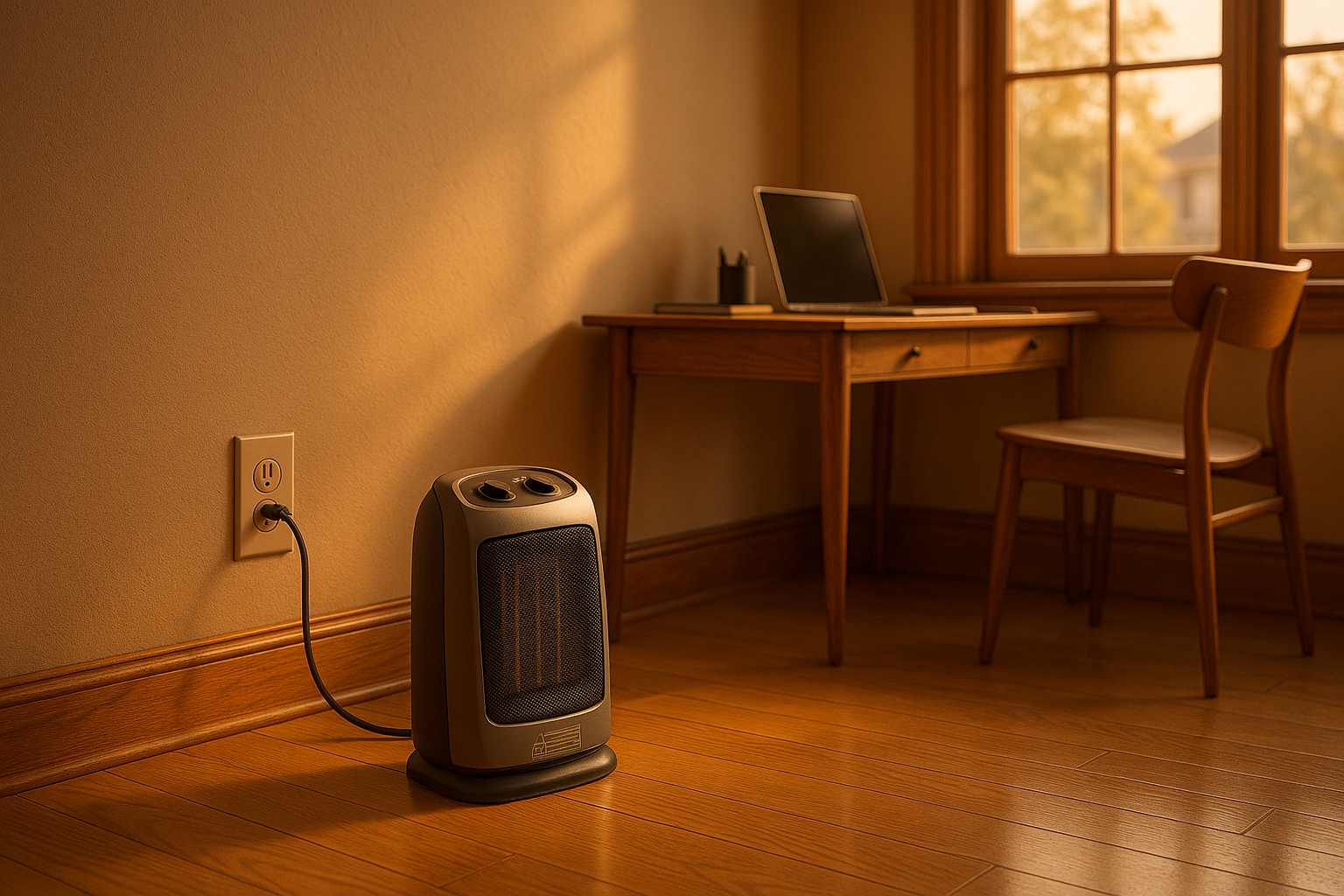
Never plug a space heater into a power strip or extension cord. Those things aren't built for that kind of sustained draw. Plug it straight into the wall outlet. Keep at least 3 feet of clear space around the heater—no curtains, blankets, or paper. Put it on a flat, stable surface where it won't tip over. And look for a model with tip-over and overheat shutoffs. They're standard now, but if you have an old one without that, get rid of it.
And no, electric space heaters do not produce carbon monoxide. That's a myth. They have no flame, no combustion. So you don't need a CO detector because of a space heater. But you should still have working CO detectors in your home for your furnace or water heater, especially during a hard winter. And don't run a space heater overnight or when you're not in the room. That's when small problems become big fires.
If You're Using a Space Heater Every Day, Something Else Is Wrong
I hear this all the time from homeowners in older neighborhoods like Meridian-Kessler, Broad Ripple, and Irvington. One room is always cold, so they run a space heater from October to March. That's not a heating plan. That's a symptom. Cold rooms usually mean your ductwork is unbalanced, you're missing returns, your insulation is thin, or your furnace isn't moving air like it should.
Frequent space-heater use is a signal that your central system isn't doing its job. If every winter you're dragging a heater into the finished attic or that bedroom over the garage, there are better long-term fixes. Duct balancing and sealing can push more warm air into that cold spot. Adding a dedicated return can stop pressure imbalances. Upgrading to a variable-speed furnace can even out temperatures by running longer at lower speeds—check out our comparison of two-stage vs variable-speed furnaces. For those tricky bonus rooms or finished attics, a small ductless mini-split might be cheaper to run than a space heater and it won't turn into a fire hazard. We wrote a detailed piece on heating a finished attic in Indiana if that's your situation.
Some older Indianapolis homes still have boilers and radiators, and they have their own quirks when it comes to heating costs. But the same rule applies: if you're constantly using a plug-in heater, something is off. You can read more about boiler and radiator heat in older Indianapolis homes if that's your setup.
What to Do Next
If you're tired of watching your electric bill climb every January and you're ready to stop babysitting a portable heater, give us a call at HVACPros. We serve Indianapolis and all the surrounding areas—Carmel, Fishers, Zionsville, Westfield, Noblesville, Greenwood, Brownsburg, Avon, Plainfield. We'll come out, check your furnace and airflow, and tell you what's actually causing that cold room. Could be a simple damper adjustment or a leaky duct. Could be a bigger fix that pays for itself in two winters.
Stop guessing. A quick comfort and safety check can show you how to reduce space-heater dependence and lower your monthly energy costs. Get a quote for our diagnostic service here.
Ready for HVAC service or an upgrade?
NATE-certified techs, flat-rate diagnostics, and a free in-home assessment for any replacement — no pressure.