Last July, my neighbor Dave in Fishers called me, half-panicked. His AC had conked out for the third time that summer. Tech had already replaced a capacitor, then a fan motor, and now the compressor was making a sound like a dying lawnmower. He'd spent $900 on repairs and still wasn't cool. "Do I put another band-aid on it or just bite the bullet?" he asked. That's the AC repair vs replacement decision every local homeowner eventually faces. And it's never as simple as a price tag.
Cooling around here—Indianapolis, Carmel, Noblesville, all of central Indiana—means dealing with sticky humidity and the occasional heat wave that pushes older systems past their limit. So let's walk through how to think about this, practically and without the fluff.
The magic number: age and the 50% rule
First, look at your unit's age. Most central ACs in Indiana last 12–15 years, sometimes less if maintenance was spotty. If yours is past the decade mark, any pricey repair should make you pause. There's this thing called the 50% rule: if a repair costs more than half of what a new system would run, replacement is usually smarter. Not a hard law—more like a gut check. Say a compressor replacement is $2,800 and a new, mid-range AC is $5,500 installed. You're basically gambling that nothing else breaks soon. And on a 14-year-old system, that's a risky bet.
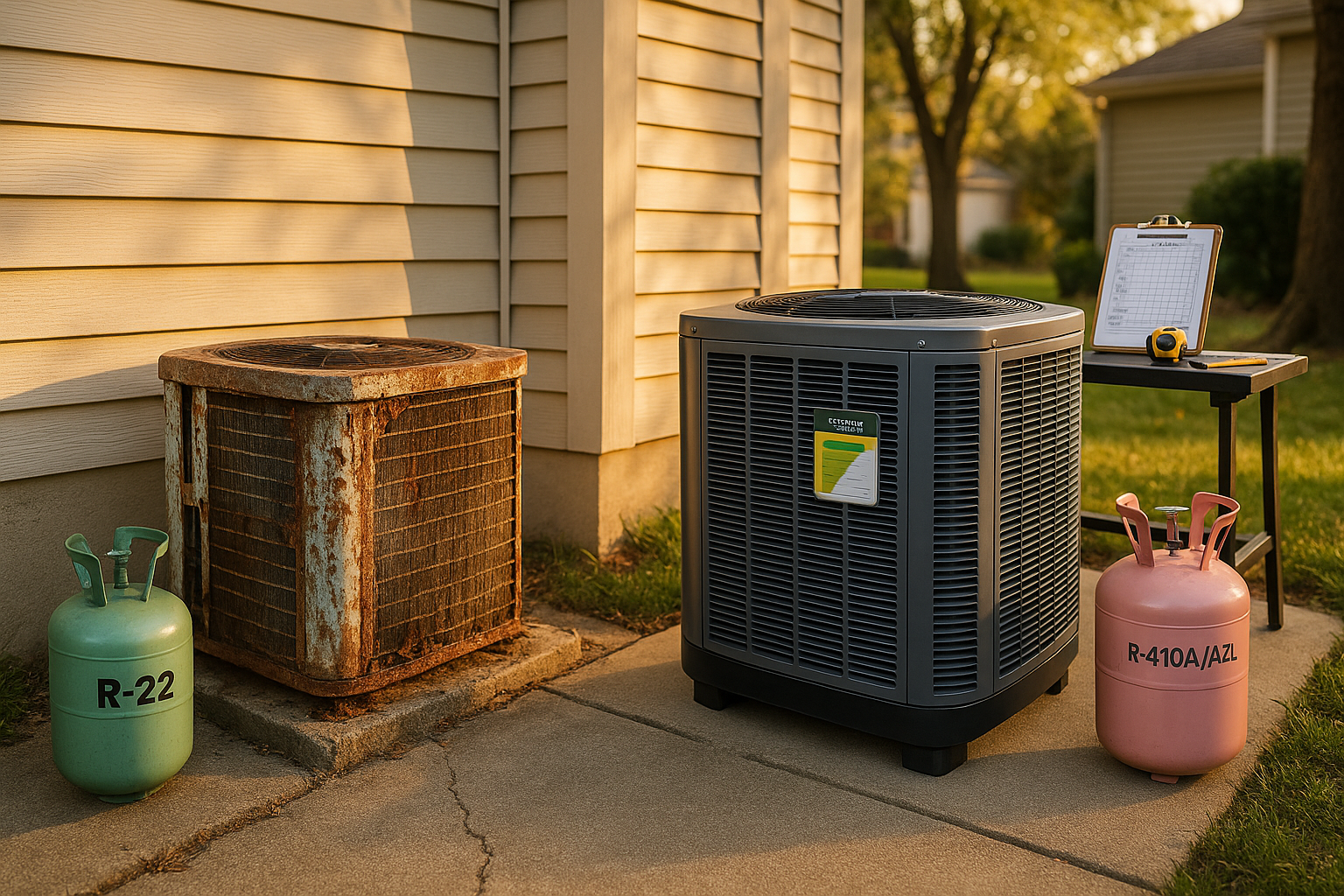
I've seen folks in Zionsville and Westfield cling to an old R-22 unit, pouring money into it every June. One guy I know spent $1,200 on a coil repair only to have the compressor die three weeks later. He could've put that toward a new system and slept better.
Refrigerant realities: R-22 is a dead end
Speaking of R-22—that old refrigerant got phased out years ago. Supplies are low, prices are high. A simple refrigerant top-off can cost hundreds, and if your system has a leak, you're just renting time. Some techs might still charge an older R-22 unit, but it's like putting premium gas in a clunker. You're better off upgrading to a newer R-410A or even the latest A2L refrigerant, which the industry is moving toward. Plus, newer units hit higher SEER2 efficiency ratings, which actually means lower summer bills. For Fishers homeowners watching their Duke Energy bill spike in August, that's real money.
Comfort isn't just about cold air
Now, let's talk about what repair often doesn't fix: comfort. If your AC short cycles (kicks on and off constantly), leaves some rooms hot while others feel like a meat locker, or can't knock down the sticky humidity, a repair probably won't solve it. Those are often signs of bad sizing or ductwork issues. A new variable-speed system, sized right, runs longer at lower speeds. That pulls more moisture out of the air and keeps temps even. In Indiana's muggy July, that's the difference between feeling clammy and feeling crisp.
I was out in Greenwood last week and a homeowner told me she'd never realized how much more comfortable her new two-stage AC was until she visited a friend still struggling with an old single-stage unit. "You don't know what you're missing," she said. And noise—if your condenser sounds like a helicopter, a newer unit can be whisper-quiet.
Don't skip the load calculation
When replacement is on the table, don't let anyone just swap your old 3-ton for a new 3-ton. A Manual J load calculation is a real thing—it measures your home's specific heat gain. Square footage, window direction, insulation, even how much shade your house gets. Without it, you might get an oversized system that short cycles and doesn't dehumidify, or an undersized one that can't keep up. We've seen homes in Fishers built in the 90s with ductwork that's leaky or just designed weird. Fixing that during replacement is the kind of thing that makes a new system shine.
What about heat pumps?
In central Indiana, a modern heat pump paired with a gas furnace (dual fuel) is worth a look. They've gotten so good in cold weather that they can handle our winters effectively, and in summer, they're just as efficient as a standard AC. Plus, you might qualify for rebates and tax credits—we'll touch on that. For a lot of families, it means steadier comfort year-round and lower heating bills when it's mild. We talk about this more in our heat pump cold weather performance guide, but suffice to say, it's not just a southern thing anymore.
Money stuff: rebates, financing, and total cost
I get it—new ACs aren't cheap. In Indianapolis, expect to pay anywhere from $5,000 to $12,000+ installed, depending on efficiency and features. But that's not the whole picture: there are Indiana rebates and federal tax credits that can knock the price down (we break them down here). And many local companies, including us, have financing options that break it into monthly payments. Don't let sticker shock push you into a repair that'll nickel-and-dime you for years.
Some homeowners worry, "I might move in a couple of years—why invest now?" Fair point. But a working, efficient AC is a selling point. A busted one? Not so much. Plus, you'll enjoy the comfort while you're still there.
Also, when you get a quote, make sure it's not just the unit. Permits, code updates (like pad, disconnect, line set), and any duct modifications should be in there. Surprises on install day are no fun.
What to do next
Here's the bottom line: if your AC is over 10–12 years old, uses R-22, or needs a compressor or evaporator coil, don't just reflexively say "fix it." Get a full picture. We do this thing called an AC Repair vs. Replace Assessment. We check your refrigerant, test static pressure, measure your ductwork, do a load calc, and show you side-by-side numbers: repair cost now vs. replacement cost with projected 5-year savings. No pressure, no sales pitch.
You can even just start by getting a quote and we'll come out and give you that honest assessment. It's free, and you'll have real data to decide. Just like my neighbor Dave—he went with a mid-range replacement and told me later he wished he'd done it two summers ago.
Don't sweat through another August. Let's figure out the smart move for your house.
Ready for HVAC service or an upgrade?
NATE-certified techs, flat-rate diagnostics, and a free in-home assessment for any replacement — no pressure.